
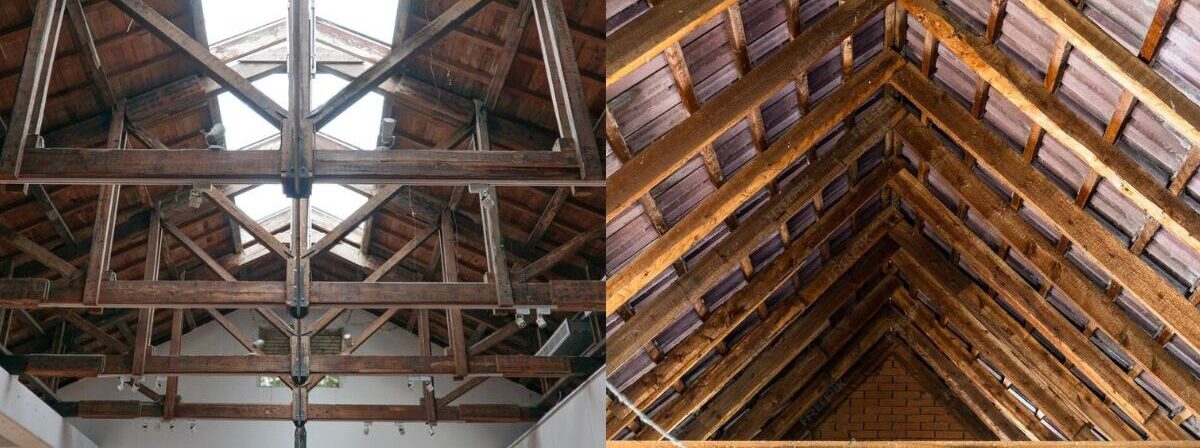
Church roof framing usually comes down to two options: rafters or trusses. In most cases, the trade-off is straightforward. Rafters are often the better fit for preserving historic character, accommodating complex rooflines, and keeping exposed wood structure. Trusses typically make more sense for long sanctuary spans, faster installation, and more predictable engineering and costs.
Here’s how rafters vs trusses compare, and what that means for your church’s next project.
Table of Contents
Key Takeaways✔ Rafters are often the best fit for historic character and complex rooflines. ✔ Trusses are often the best fit for long spans and faster installation. ✔ Rafters vs trusses mainly comes down to how roof loads move through the structure. ✔ Trusses vs rafters decisions often result in a hybrid approach on church projects. ✔ Church restoration companies should evaluate existing conditions before you choose a system. |
What Is a Rafter?
A rafter is a sloped structural member that runs from the ridge (or high point) of the roof down to the exterior wall, forming the main framework that supports roof sheathing and roofing materials. A set of roof rafters creates the roof shape, and can be paired with ceiling joists or a ridge beam depending on design.
Common Uses of Rafters in Church Buildings
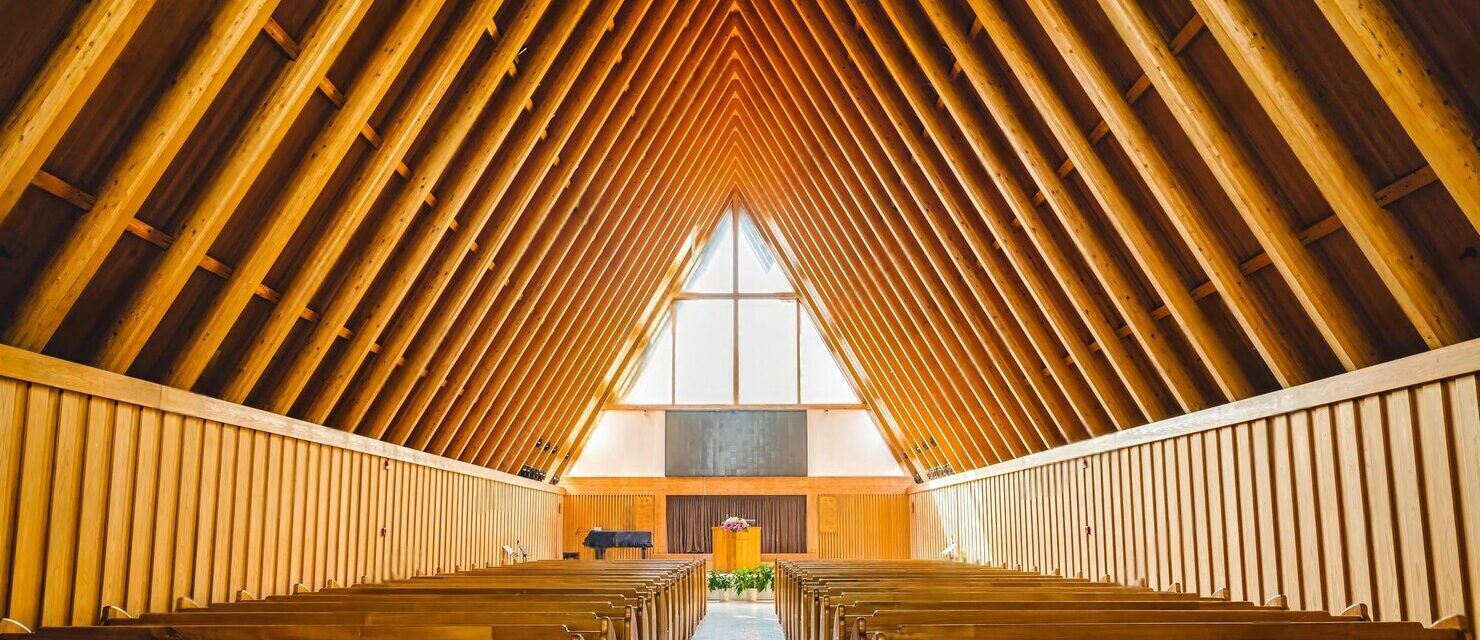
Rafters are common in older and traditionally built churches because they support:
- Complex roof geometry: Unusual pitches, dormers, and intersecting rooflines.
- Exposed interior woodwork: Aesthetic ceilings where structure is part of the visual experience.
- Historic framing methods: Many legacy church structures were built with heavy timber and traditional joinery, including rafter-based systems in steeples and spires.
Pros and Cons of Roof Rafters for Churches
Pros of Rafters
- Design flexibility: Rafters can be cut and adjusted on-site, which helps when a church has nonstandard geometry, settled walls, or rooflines that are not perfectly square, common issues in older buildings.
- Historic compatibility: In many traditional sanctuaries, rafters match the original framing approach, which can make repairs, reinforcement, and partial replacements more seamless and preservation-friendly.
- Visual authenticity: Exposed rafters support the “crafted” look many congregations want to retain, especially in vaulted ceilings where the structure is part of the worship space’s character.
- Easier targeted repairs: Individual damaged rafters can sometimes be sistered, reinforced, or selectively replaced without rebuilding the entire roof system.
- More flexibility for future changes: If your church anticipates future skylights, dormers, or ceiling modifications, rafters can be simpler to adapt, as long as changes are properly designed and permitted.
Cons of Rafters
- More on-site labor: Rafters usually require skilled carpentry, layout, and cutting in the field, which can increase labor costs and extend timelines, especially in tight urban job sites.
- Span limitations: Very wide sanctuaries may need additional structural solutions such as ridge beams, engineered members, or interior supports, which can affect interior openness.
- Greater variability: Field-built systems can vary based on crew methods and site conditions, which can make estimating and scheduling less predictable than factory-built components.
- Potential for more material waste: On-site cutting and fitting often generates more scrap compared with pre-manufactured systems.
- Complexity in older structures: If existing walls are out of plumb or there is historic movement, aligning a new rafter system can be time-intensive and may require additional engineering coordination.
What Is a Truss?
A truss is an engineered triangular framework designed to carry loads efficiently through chords and webs. Roof trusses are typically built off-site under controlled conditions and delivered to the jobsite for installation.
Building codes treat trusses as engineered components. The International Building Code requires truss design drawings and may require them to be sealed and signed when the design professional or local authority requests it.
Common Uses of Trusses in Religious Buildings
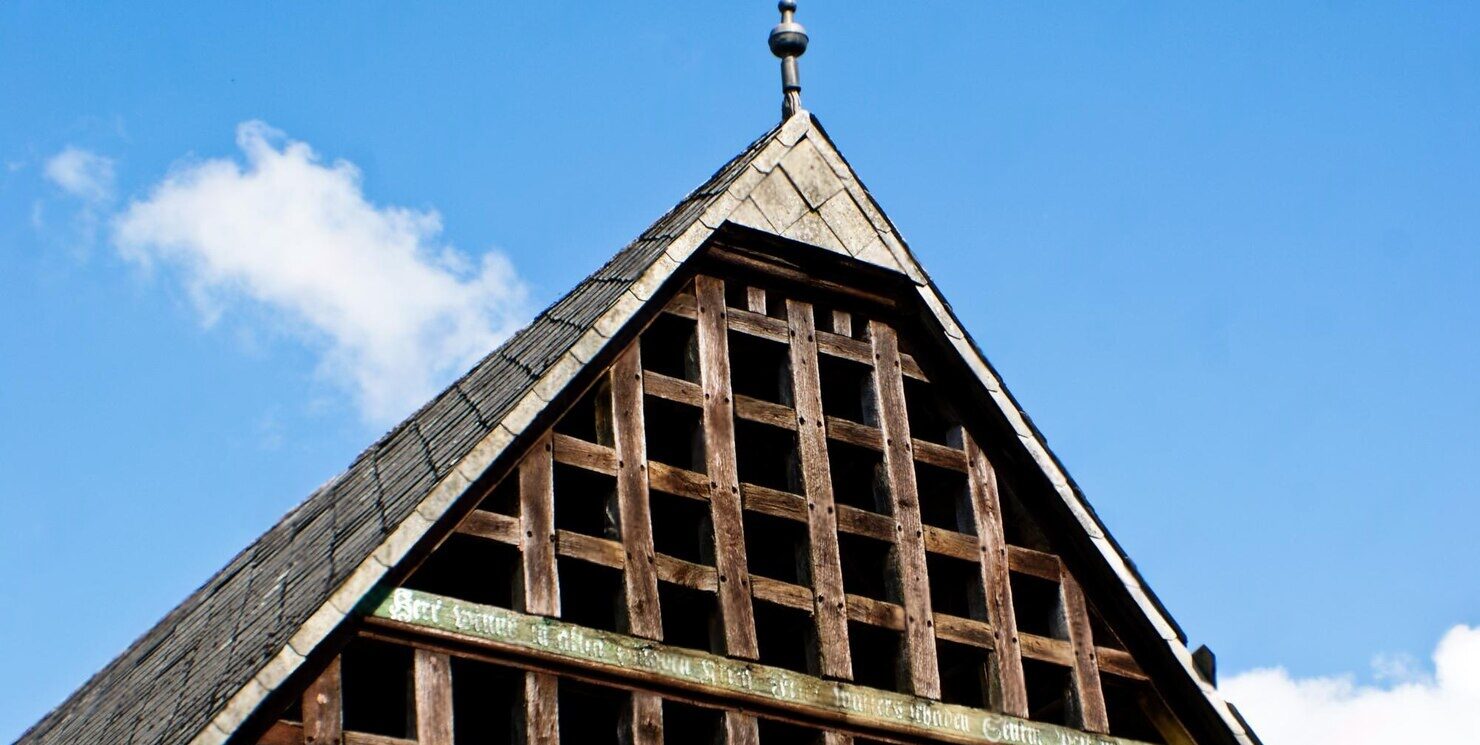
There is a long tradition of timber truss systems in historic buildings, including churches, where trusses were designed to handle large spans long before modern plates and connectors
Trusses show up often in:
- New church construction: Especially where speed and predictable costs are priorities.
- Large-span sanctuaries: Where you want open interiors without intermediate bearing walls.
- Fellowship halls and expansions: Where simpler rooflines allow economical, repeatable framing.
Pros and Cons of Trusses for Churches
Pros of Trusses
- Span efficiency: Trusses are engineered to cover wide spaces with fewer interior supports, making them a strong option for open sanctuary layouts and multi-use worship areas.
- Installation speed: Off-site fabrication typically reduces on-site framing time, which can shorten the disruption period for congregations and help projects stay on schedule.
- Predictable engineering: Loads and performance are calculated and documented before installation, supporting consistency across the roof and clearer inspection and approval pathways.
- Cost control on straightforward roofs: For simpler rooflines, trusses can reduce labor hours and help keep budgets more predictable compared with fully site-built framing.
- Consistency and quality control: Factory production can improve uniformity, which is helpful when a project requires repeatable framing across long runs.
Cons of Trusses
- Less flexibility in the field: Trusses are engineered products, so changes often require review and redesign; even small “on-site fixes” can create structural risk if done without approval.
- Aesthetic limitations: If your church wants exposed structure, standard trusses may not deliver the desired look without upgrading to specialty timber trusses or designing an architectural ceiling system.
- Mechanical constraints: Some truss configurations can limit where HVAC, lighting, sprinklers, or AV can run, so coordination has to happen early to avoid conflicts later.
- Shipping and staging challenges: Trusses can be large, and urban sites may need careful planning for delivery, crane access, and storage, especially in NYC.
- Not always restoration-friendly: In historic buildings, introducing trusses can change load paths and connection points, potentially requiring more reinforcement work to make the new system compatible with old masonry and framing.
Rafters vs. Trusses for Church Buildings
Structural Differences
If you are deciding between rafters vs trusses for a large, open sanctuary, trusses often make spanning simpler and more predictable. If you are preserving a historic roof shape, rafters may be easier to integrate without changing how the building was intended to carry loads.
Rafters
Loads flow down through individual sloped members into exterior walls and supporting framing. This can work especially well when a church’s roof is complex or when the existing structure was originally designed around rafter framing.
Trusses
Loads spread through a triangulated web, which helps the roof act as a single engineered system. That efficiency often makes trusses a practical solution for long spans and wide sanctuary layouts where you want fewer interior supports.
Cost and Installation Differences
Cost is not just about lumber. It is about labor, scheduling risk, and how much “unknown” you might uncover once work begins.
Rafters
Typically mean more on-site carpentry hours, more layout work, and more custom fitting, especially in older churches where walls and rooflines may not be perfectly square.
Trusses
Usually require upfront engineering and fabrication, but can reduce on-site framing time because the components arrive ready to set and secure.
Design and Aesthetic Impact
Your choice affects how the sanctuary looks and feels, not just how it stands.
Rafters
Often support exposed structure, vaulted character, and the crafted interior look many churches want to retain or restore.
Roof trusses
Often work best when the ceiling is designed to align with the truss profile, whether that is a flat ceiling system or a planned vaulted assembly.
Which Roof System Is Best for Your Church?
Use these practical filters when deciding rafters vs trusses and trusses vs rafters.
- Building age and historic status: Older or landmarked churches often lean toward rafters or timber truss restoration methods.
- Span and interior needs: Larger open worship spaces often lean toward roof trusses or engineered hybrid framing.
- Aesthetic goals: If the structure is meant to be seen, rafters and specialty timber systems tend to win.
- Timeline and disruption: If minimizing closure time matters, trusses may support a faster framing phase.
- Future maintenance: Choose what can be inspected, maintained, and repaired without guesswork.
How Church Restoration Companies Evaluate Rafters and Trusses
Experienced church restoration companies typically start with documentation and load-path thinking, not preferences.
- Field inspection and measurement: Confirm member sizes, connections, and signs of movement.
- Load review: Roof dead loads, wind exposure, and snow requirements must be accounted for. NYC code language ties roof snow design to ASCE methods, and NYC-adopted guidance lists 25 psf ground snow load as a baseline reference for design snow load determinations.
- Documentation before removal: Preservation best practice emphasizes careful examination and recording before replacement so historic fabric is not lost unnecessarily.
- Engineering coordination for trusses: Because trusses are engineered components, they require proper design drawings and review pathways.
This is also where people-first decision-making matters. The “best” system is the one that respects safety, mission continuity, budget stewardship, and the building’s story.
Frequently Asked Questions (FAQs)
When should I use rafters?
Use rafters when the project involves historic restoration, complex or irregular rooflines, exposed wood structure, or when you need flexibility to adapt framing on site to existing conditions.
What are common rafter mistakes to avoid?
Common mistakes include undersizing members, poor connection detailing, ignoring wall alignment or settlement, and making field changes without structural review.
How far can a roof rafter span without support?
Span limits vary with load, spacing, wood species, and lumber grade, so longer spans typically require larger members or engineered support. As an example, a 2×6 rafter spaced 16 inches on center can span up to about 13 feet 5 inches without intermediate support. Larger spans typically require engineered members or additional support.
What is the rule of thumb for trusses?
A common rule of thumb for truss proportions is based on depth-to-span ratios. For timber trusses, the economical ratio is roughly 1:6 to 1:10. Typical spacing for timber roof trusses ranges from 12 to 27 feet, depending on design and loading. Trusses should always be engineered for the specific building and loads.
Do roof trusses eliminate load-bearing walls?
Roof trusses can often reduce or eliminate interior load-bearing walls by transferring loads directly to exterior walls or designated supports, but this depends on the truss design and overall structural system.
Schedule a Church Roof Evaluation in NYC With Artech Church Interiors, Inc.
Roof framing decisions in NYC churches are rarely straightforward. Older masonry, landmark considerations, tight access, and decades of repairs can all affect what is realistic and what will last.
Artech Church Interiors, Inc. in NYC helps churches and religious facilities make informed choices, whether that means repairing roof rafters, restoring a historic rafter system, or evaluating engineered trusses and roof trusses for an addition or rebuilding scope
Contact us today for a consultation.