

Church building projects are shifting toward faster schedules, more predictable costs, and larger, unobstructed worship spaces. One reason is the widespread use of factory-built framing systems. In a 2019 National Association of Home Builders report, over 70% of builders and remodelers said they use roof trusses, showing how common this approach has become in modern construction.
That’s why it helps to understand what trusses do and what truss installation means for a church project from day one.
What's Inside
Essential Points
- Trusses span wide roofs and transfer loads to supports.
- Roof trusses help create column-free worship spaces.
- Truss design uses triangles to distribute roof, wind, and snow loads.
- Factory-built trusses speed builds and improve predictability.
- Truss installation works best with correct truss spacing and bracing
What Are Trusses?
Trusses are engineered frameworks made of connected members that form a rigid shape, most often a series of triangles. The triangle matters because it resists shape change under load, which helps the structure stay stable when weight from the roof, wind, or snow pushes down or sideways.
Main parts of a truss include:
- Top chord: The upper members that typically follow the roofline and carry compression forces.
- Bottom chord: The lower member that often acts like a ceiling tie and helps resist spreading forces.
- Web members: The internal diagonals and verticals that create triangles and move loads through the system.
- Connections: Fasteners and connector plates that transfer forces between members.
- Load path: Roof loads move into the truss, then into bearing walls or support points, then down to the foundation.
What Are Trusses Used For?
At their core, trusses are used to create strong, lightweight frameworks that support wide roof spans and transfer loads safely into the building’s walls or other structural supports. In church construction, that purpose is especially valuable because it helps create open worship spaces with fewer interior obstructions, while maintaining long-term stability and structural efficiency.
Supporting Large Spans Without Interior Columns
One of the most common uses for trusses is spanning wide distances without posts or columns interrupting the space below. For churches, that often means:
- Clear sightlines from seating to the pulpit, stage, or altar.
- More flexibility for seating layouts and aisles.
- Fewer structural obstacles for lighting, screens, and acoustical planning.
Distributing Weight to Walls or Support Points
Trusses are designed to move roof weight and environmental loads to specific bearing points. Instead of concentrating loads in a few heavy beams, the geometry helps spread forces efficiently to walls or supports, which can reduce structural “hot spots” when properly engineered.
Creating the “Skeleton” of a Building
In many buildings, trusses function like a structural skeleton. They define the roof shape, stabilize the building’s upper structure, and create a platform for roof decking and coverings. In church projects, roof trusses often do the heavy lifting of forming both the roofline and the interior ceiling volume.
Why Churches Often Choose Trusses Instead of Other Structural Systems
Trusses are often chosen because they can span large areas efficiently, arrive pre-engineered for smoother construction, and adapt to a wide range of church architectural styles. This is why many church restoration companies rely on them without sacrificing structural reliability.
Wide Worship Spaces
Churches frequently prioritize uninterrupted space for worship, music, and community gatherings. Roof trusses can help support broader sanctuary layouts without interior columns, which is especially valuable in assembly-type spaces where people gather in one main room.
Faster Construction Timelines
Many truss systems are designed off-site and delivered as labeled components ready for placement. This shift toward off-site and prefabricated building methods is part of a broader construction trend aimed at reducing schedule pressure and improving jobsite efficiency.
Cost-Effectiveness Without Overpromising
Because trusses are typically pre-engineered and produced in controlled settings, they can reduce the amount of complex stick-framing labor on site and improve predictability. The goal is not “cheap,” but fewer surprises: clearer scopes, repeatable installation steps, and fewer field modifications when the project is coordinated correctly.
Flexibility for Church Architecture
With the right truss design, churches can support traditional pitched rooflines, modern worship center profiles, or taller interior volumes for a more spacious sanctuary feel. Trusses can also be shaped to accommodate architectural goals like vaulted ceilings or decorative interior treatments when planned early.
Types of Trusses Used in Church Construction
Churches choose different roof trusses based on span length, ceiling goals, and how the space will be used for worship, music, and community events. Many church restoration companies evaluate these factors early, since the best fit comes down to truss design based on specific goals.
King Post Truss
Best for: Shorter spans and simpler church spaces
A king post truss is one of the most traditional forms, often used where the span is modest and the roof framing does not need to cover a wide sanctuary footprint. In church construction, it commonly fits:
- Smaller chapels or prayer rooms
- Office and education wings
- Entry connectors or covered transitions
Queen Post Truss
Best for: Moderate spans that need more openness than a king post
A queen post truss extends the workable span by adding vertical members and creating a stronger internal framework. Churches may lean toward this option for mid-sized gathering areas where column-free space is helpful but a large sanctuary truss system is not necessary. Common fits include:
- Fellowship halls
- Youth rooms and multipurpose spaces
- Medium-sized worship rooms
Fink Truss
Best for: Efficient load distribution and repeatable framing layouts
The fink truss is widely used and recognizable for its “W-web” pattern, which creates multiple triangles to distribute loads effectively. Churches often use fink-style roof trusses in spaces that benefit from a predictable, efficient roof system, such as:
- Large classroom wings
- Community rooms
- Support buildings on a church campus
Scissor Truss
Best for: Vaulted or cathedral-style interiors in worship spaces
Scissor trusses are frequently chosen when a church wants more interior height and a vaulted ceiling feel without switching to a different structural system. Instead of a flat bottom chord, the bottom members slope upward, creating a taller interior profile. For sanctuaries, this can support:
- A more open, uplifted visual experience
- Better integration of tall front stages or choir lofts
- Ceiling shapes that complement traditional church architecture
Modified and Custom Truss Profiles
Best for: Unique rooflines, transitions, and signature church architecture
Many church projects call for custom profiles, especially renovations or expansions where new structure must tie into existing framing. Modified trusses are useful when the building includes:
- Distinctive rooflines that define the sanctuary exterior
- Transitions between sanctuary, lobby, and classroom wings
- Architectural features like varying roof pitches or raised center sections
How Truss Installation Works: Step-by-Step Overview
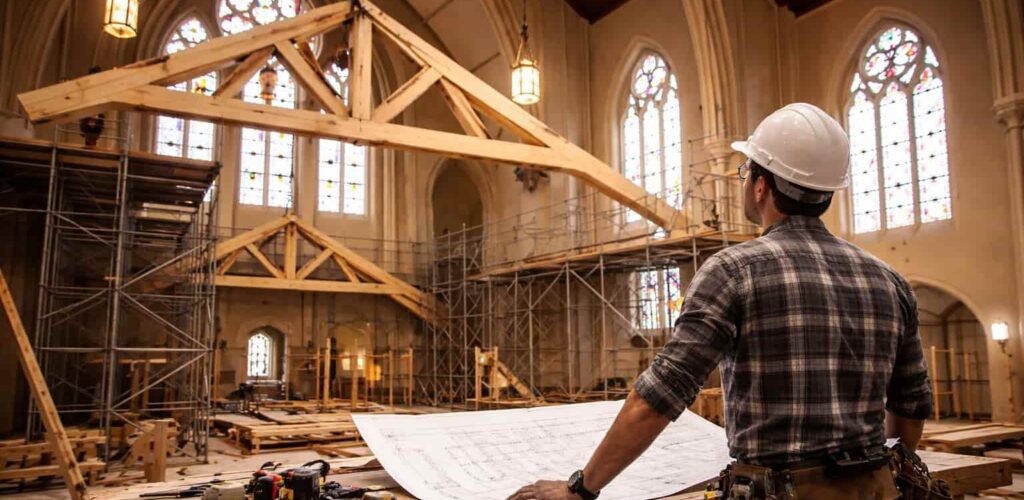
A successful truss installation process depends on planning, precision, and safety at every stage. Because roof trusses are engineered to work as a complete system, the best results come when the build team follows the placement plans closely.
Step 1: Finalize Plans and Engineering
A successful project starts with finalized drawings that coordinate truss design with the church layout, roof shape, and intended interior ceiling form. If the church plans future AV upgrades, that conversation should happen now so loads and attachment points are addressed appropriately.
Step 2: Prepare the Site and Supporting Structure
Before truss installation, bearing walls, beams, and connection points need to be built to the right dimensions and kept square and level. Small deviations can create bigger issues once large components are set.
Step 3: Deliver Trusses and Inspect Before Placement
Delivered roof trusses should be checked for damage and verified against placement plans. Clear labeling and staging matter because a sanctuary roof system may include multiple truss profiles.
Step 4: Set Trusses in Place
During truss installation, crews typically place trusses in a planned sequence so alignment stays consistent and bracing can be installed as they go. Large-span trusses often require coordinated lifting and stable temporary support.
Step 5: Secure Bracing and Stabilization
Bracing is not optional. Proper restraint during truss installation keeps members from shifting before the roof deck ties the system together. This step is essential for safety and long-term performance.
Step 6: Install Roof Sheathing and Roofing System
Once sheathing is installed, the roof diaphragm helps lock the system in place and distribute lateral loads. This is where the truss system transitions from “set components” to a unified roof structure.
Step 7: Final Inspection and Structural Review
A final review confirms truss placement, bracing, and connections match the design intent. Any field changes should be documented so the system remains consistent with engineered assumptions.
Frequently Asked Questions (FAQs)
Are trusses stronger than beams?
It depends on the job. Trusses are engineered to be very efficient for spanning large distances by distributing loads through triangles, while beams are better for concentrated loads or specific point supports. For long, open areas, roof trusses often outperform a single beam in efficiency and material use.
When should you use trusses?
Use trusses when you need a cost-effective way to span wide areas, create open interiors without columns, and keep framing consistent. They are especially common for roof trusses in sanctuaries, fellowship halls, and other large church spaces where truss design and truss spacing can be engineered to meet the span and load requirements.
What are the disadvantages of trusses?
Common drawbacks include limited flexibility for changes after fabrication, restrictions on cutting or drilling members, and the need for precise bracing during truss installation. Some truss profiles can also reduce usable attic space compared with certain stick-framed roof systems.
Can I walk on my trusses?
Only if a qualified professional confirms it is safe. Many roof trusses are not designed for foot traffic beyond construction and maintenance needs, and stepping in the wrong place can damage members or connections. If access is needed, it should be planned as part of the truss design and construction approach.
Are trusses the same as joists?
No. Trusses are triangulated frameworks that transfer loads to supports, while joists are typically single framing members that support floors or ceilings. Roof trusses can include a bottom chord that supports ceilings, but they are still a different structural system than joists.
Planning a Church Renovation or New Build in Connecticut?
Artech Church Interiors, Inc. is one of the most trusted church restoration companies that works with churches and religious institutions on spaces built for worship, community use, and long-term stewardship.
If you’re planning a sanctuary build, expansion, or roof retrofit in Connecticut, define your span, ceiling, and future equipment needs early so truss installation matches how your congregation uses the space.
Contact Artech Church Interiors, Inc. to get started on your project.