
What’s In This Guide
- What Types of Flooring Are Used in Church Sanctuaries?
- How Does Flooring Affect Sound Quality in a Boston Sanctuary?
- What Are the Best Flooring Options for Historic Boston Churches?
- How Does New England’s Climate Affect Church Flooring Decisions?
- How Does Sanctuary Flooring Affect Accessibility for Boston Congregations?
- How Do You Choose the Right Sanctuary Flooring for Your Church?
- What Should a Church Committee Ask Before Starting a Flooring Project?
- Frequently Asked Questions (FAQ)
- Ready to Plan Your Church Flooring Project in the Boston Area?
Flooring is one of the most important decisions a church renovation committee will make. In Boston-area sanctuaries, the choice affects sound quality during worship, congregation safety on wet winter mornings, compliance with historic preservation requirements, and the long-term maintenance budget.
Quick Facts
- Hardwood church floors last 75 to 100+ years with proper maintenance and can typically withstand 3 to 5 refinishing cycles before replacement is needed.
- Commercial carpet for churches carries an NRC (Noise Reduction Coefficient) between 0.30 and 0.65, depending on pile weight and underlayment.
- Boston churches built before 1978 may contain lead paint or asbestos-containing adhesives beneath existing flooring, requiring licensed abatement before new installation begins.
- The Secretary of the Interior’s Standards for Rehabilitation recommend preserving original flooring materials wherever structurally feasible.
- Church renovation companies in MA frequently recommend hybrid floor plans: hardwood or stone in the nave with carpet runners in the aisles to balance acoustics and comfort.
What Types of Flooring Are Used in Church Sanctuaries?
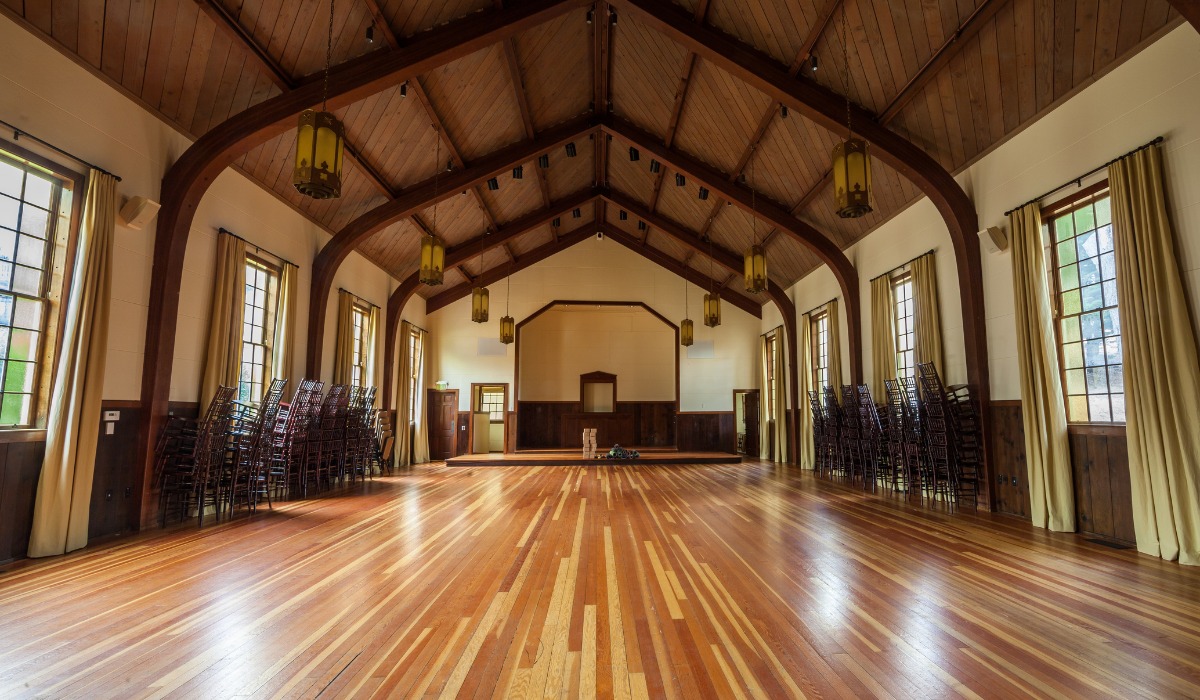
Most sanctuary flooring falls into five categories: hardwood, stone or slate, ceramic tile, carpet, and luxury vinyl plank. Each material performs differently across sound, safety, maintenance, and historic compatibility.
|
Material |
Typical Lifespan |
Acoustic Behavior |
Best Location |
|
Hardwood |
75–100+ years |
Reflective |
Nave, choir loft |
|
Stone/Slate |
100+ years |
Highly reflective |
Nave, narthex |
|
Ceramic Tile |
50–75 years |
Reflective |
Narthex, vestibule |
|
Carpet |
10–15 years (high traffic) |
Absorptive |
Aisles, chancel |
|
Luxury Vinyl Plank |
15–25 years |
Slightly reflective |
Fellowship hall, offices |
How Does Flooring Affect Sound Quality in a Boston Sanctuary?
Flooring directly controls how sound behaves in a worship space. Hard surfaces reflect sound waves and increase reverberation time. Soft surfaces absorb them and reduce echo.
Many older Gothic and Colonial Revival churches in Boston already have longer reverberation times due to stone walls and vaulted ceilings. Flooring is often one of the few acoustic variables a renovation committee can realistically control within budget.
Key acoustic terms for committee presentations:
- NRC (Noise Reduction Coefficient): A rating from 0.00 (fully reflective) to 1.00 (fully absorptive). Standard carpet falls in the 0.30 to 0.55 range depending on pile depth, with certain carpet-and-cushion combinations reaching NRC values as high as 0.70.
- RT60: The time in seconds for sound to decay by 60 decibels after the source stops. Speech-led worship performs best with RT60 values of 0.8 to 1.2 seconds. Music-led worship typically benefits from 1.5 to 2.0 seconds.
- Speech Intelligibility: Fully carpeted sanctuaries may over-dampen sound, especially in larger worship spaces where speech clarity matters. This is a common concern in larger Boston congregations with heavy liturgical programming.
A hybrid approach, combining hard floors in the nave with carpet runners in the aisles, balances acoustic clarity with seating comfort.
What Are the Best Flooring Options for Historic Boston Churches?
Is Hardwood the Right Choice for a Historic Sanctuary?
Hardwood is a common original flooring material in many historic New England churches and is typically the most preservation-appropriate choice. The Secretary of the Interior’s Standards for Rehabilitation recommend retaining and refinishing original hardwood before considering replacement.
Common species found in Massachusetts sanctuaries:
- White oak (dense grain, resists wear, takes stain well)
- Heart pine (tight grain, strong historic character, increasingly rare)
- Douglas fir (common in late 19th and early 20th century builds)
Planning data for committee use:
- Refinishing cost: $3 to $8 per square foot
- Refinishing cycle: every 15 to 25 years depending on traffic
- New hardwood installation: $8 to $20 per square foot (estimate; varies by species, subfloor condition, and market)
- Minimum thickness required for future refinishing: 3/4-inch solid hardwood
Hardwood may not be appropriate at grade level in stone-foundation churches with active moisture migration. A subfloor moisture assessment is necessary before specifying any wood product for church flooring in Boston.
When Does Carpet for Churches Make Sense?
Carpet for churches performs best in secondary zones: side aisles, kneeling areas, choir lofts, and chancel platforms. Full-nave carpet may not perform well in larger Boston-area congregations with spoken liturgy because it can reduce acoustic clarity.
Specification requirements for church carpet:
- Fire rating: ASTM E648 Class I (required for places of public assembly; Class I requires a minimum Critical Radiant Flux of 0.45 W/cm²)
- Pile weight: 28 to 40 oz. for high-traffic aisles
- Replacement cycle: 10 to 15 years in high-use areas
- Installed cost: $3 to $10 per square foot
Solution-dyed nylon is the most practical fiber choice for sanctuaries that host weekly services, funerals, and community events. It resists staining, holds color through repeated cleaning, and outperforms other fibers in high-traffic conditions.
What About Stone, Slate, and Tile in Massachusetts Sanctuaries?
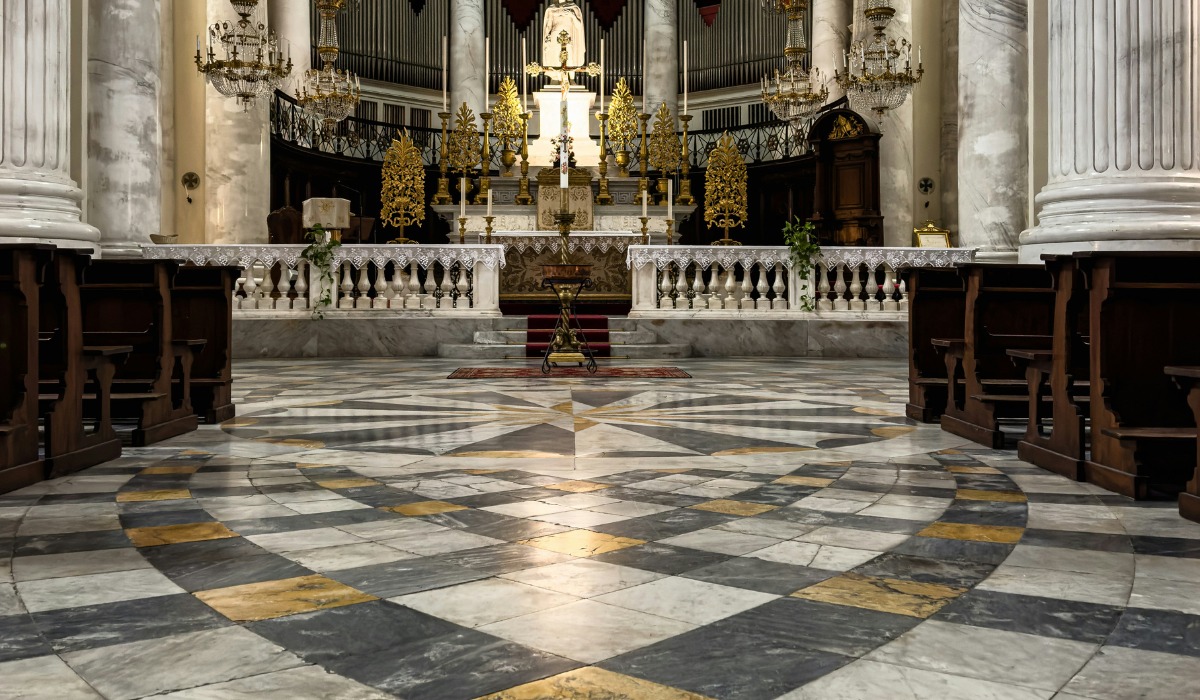
Stone and slate appear frequently in Boston-area Catholic and Episcopal churches and are historically appropriate for those building types. Both materials are highly reflective and typically require additional soft-surface elements elsewhere in the sanctuary to control reverberation.
Safety consideration: A minimum Dynamic Coefficient of Friction (DCOF) of 0.42 is the accepted standard for level interior floors expected to be walked upon when wet. Many historic stone floors fall below that threshold at building entries and may require surface treatment or protective matting.
Restoring original stone typically costs less than full replacement and satisfies preservation requirements for landmarked properties.
Is Luxury Vinyl Plank a Practical Option for Church Renovations?
Luxury vinyl plank is appropriate for ancillary spaces: fellowship halls, narthexes, sacristies, and administrative offices. Specifying it for the primary nave in a historic Boston sanctuary typically conflicts with preservation guidelines and does not match the acoustic or aesthetic character of the space.
Advantages in secondary spaces:
- Moisture-resistant core, suitable for grade-level New England installations
- Installed cost: $4 to $9 per square foot, lower than hardwood
- Minimal ongoing maintenance requirements
MORE ON THIS TOPIC: Planning a Church Renovation in New York: Costs, Timeline, and Expert Advice
How Does New England’s Climate Affect Church Flooring Decisions?
Annual average precipitation in Massachusetts ranges from 45 to 55 inches, and Boston experiences freeze-thaw cycles that stress subfloor adhesive bonds and drive moisture beneath existing floors. These conditions directly limit which materials are appropriate.
Climate risks by material type:
- Hardwood: Seasonal moisture content variation in uncontrolled sanctuaries causes expansion and contraction. Proper HVAC management and board acclimatization before installation reduce this risk.
- Stone and tile: Freeze-thaw cycles accelerate grout failure at exterior-adjacent entries and narthex thresholds.
- Carpet: Moisture tracked in during Boston winters accelerates soiling and may promote subfloor mold if the slab beneath is not properly sealed and vapor-managed.
An HVAC assessment for church flooring in Boston is standard practice among experienced church renovation companies in MA.
How Does Sanctuary Flooring Affect Accessibility for Boston Congregations?
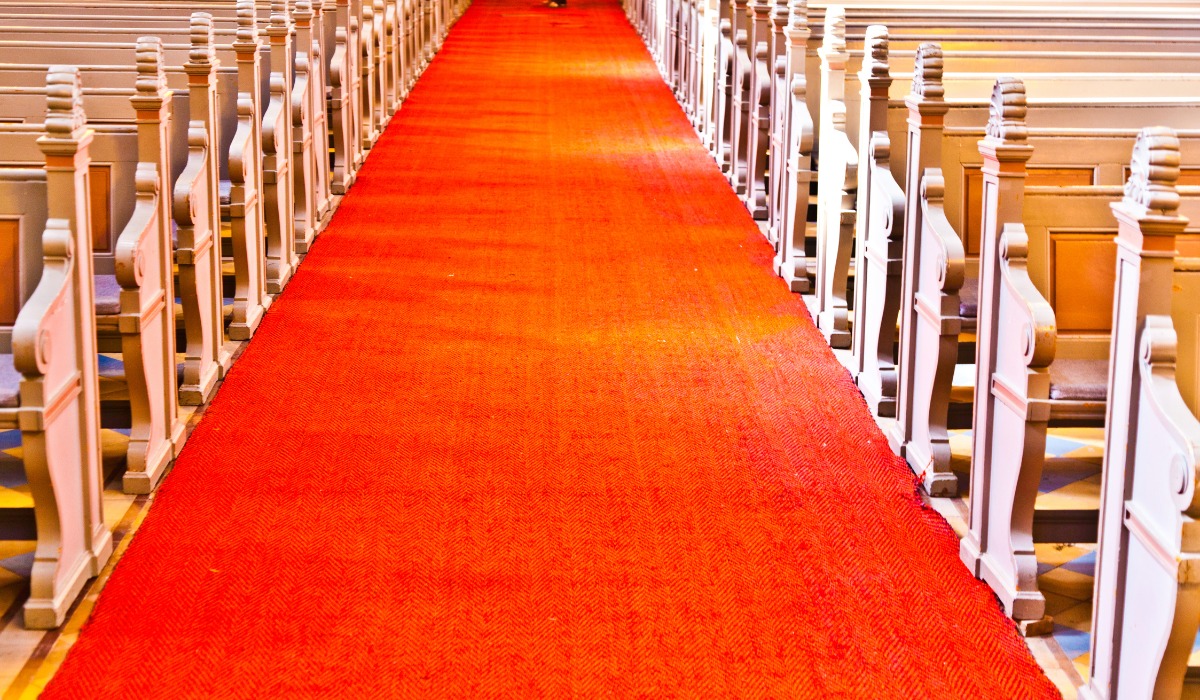
Flooring directly affects mobility, safety, and ADA-compliant circulation for elderly and disabled congregants. Abrupt transitions between materials, thick carpet piles, and uneven historic surfaces are among the most common accessibility barriers in Boston-area churches.
Key accessibility considerations:
- Carpet pile height: Keep at or below 1/2 inch to support wheelchair and walker mobility.
- Transition strips: Flush or beveled strips between materials prevent tripping hazards at zone changes.
- Slip resistance: Maintain a DCOF of 0.42 or higher at building entries and wet-exposure zones.
- Aisle width: Flooring layout must support unobstructed accessible routes throughout the nave.
Churches undergoing flooring renovations should address accessibility gaps within the same project scope to avoid duplicated disruption and cost.
How Do You Choose the Right Sanctuary Flooring for Your Church?
Step 1: Assess Subfloor and Foundation Conditions
Inspect for moisture using a calibrated moisture meter. Evaluate structural integrity and identify any existing adhesives. Boston churches built before 1978 require testing for lead-based paint and asbestos-containing materials beneath the existing floor before any removal begins, per the EPA’s Renovation, Repair, and Painting Rule.
Step 2: Identify Historic Preservation Requirements
Check for listing on the National Register of Historic Places, the Massachusetts State Register, or a Boston Landmarks Commission designation. Landmarked properties face material-specific restrictions and must submit documentation before removing or altering original flooring. Non-landmarked historic churches follow the Secretary of the Interior’s Standards for Rehabilitation.
Step 3: Define Acoustic Goals
Consider congregation size, worship style, and existing room reflectivity. Speech-led worship targets an RT60 of 0.8 to 1.2 seconds; music-led services often benefit from 1.5 to 2.0 seconds. Document acoustic goals in writing before approaching contractors.
Step 4: Set a Budget That Includes Maintenance
Build the budget in four categories:
- Subfloor preparation and abatement (variable based on conditions)
- Material and installation costs (see ranges by material above)
- Ongoing maintenance: refinishing cycles at $3 to $8 per square foot, carpet replacement, grout resealing
- Long-term replacement planning across 20 to 50 years
Step 5: Consult a Specialist Before Specifying Materials
Not every general contractor has specialized experience evaluating sanctuary flooring across acoustics, preservation compliance, and congregation workflow. Church renovation companies in MA with documented restoration experience assess all three factors as part of a site evaluation, not as add-on services.
What Should a Church Committee Ask Before Starting a Flooring Project?
Use this checklist when presenting options to trustees or putting a proposal to a congregation vote:
- Is the existing floor original to the building, and does it carry preservation significance?
- Has the subfloor been tested for moisture intrusion and hazardous materials?
- What are the acoustic goals for spoken liturgy and musical worship specifically?
- Does the material choice comply with Massachusetts historic preservation requirements?
- What is the full 20-year cost of ownership, including maintenance and replacement cycles?
- Has the HVAC system been assessed for its ability to maintain stable interior humidity?
- Can installation be phased around the active service calendar?
Frequently Asked Questions (FAQ)
How long does church flooring installation typically take?
Timeline varies by scope. Refinishing existing hardwood church floors in a mid-size sanctuary takes 3 to 7 days. New hardwood or stone installation runs 2 to 4 weeks depending on subfloor preparation needs. Phased scheduling around active service calendars is standard practice for Boston-area renovation projects.
Can hardwood church floors be refinished without full replacement?
Yes, provided the boards are solid hardwood at least 3/4 inch thick. Many original New England church floors may meet this threshold, but the board thickness should be confirmed during assessment. Solid hardwood can support 3 to 5 refinishing cycles across its lifespan, making it the stronger long-term investment over engineered alternatives.
Does carpet for churches require commercial-grade materials?
Yes. ASTM E648 Class I fire ratings are required for floor coverings in places of public assembly. Residential-grade carpet does not meet the fire rating, wear, or maintenance requirements for sanctuary flooring in Massachusetts.
How do historic preservation rules affect church flooring in Boston?
Landmarked properties under Boston Landmarks Commission or National Register designation face material-specific restrictions and must submit documentation before removing or altering original flooring. Non-landmarked historic churches follow the Secretary of the Interior’s Standards, which recommend preservation over replacement but do not legally restrict material choices.
What is the most common original flooring found in Massachusetts churches?
Heart pine and white oak hardwood are the most common original materials in New England sanctuaries built between 1850 and 1950. Slate and encaustic ceramic tile appear frequently in Catholic and High Episcopal buildings from the same period.
Ready to Plan Your Church Flooring Project in the Boston Area?
Artech Church Interiors, Inc. provides sanctuary flooring consultation, installation, and restoration services to churches throughout the Northeast, including Boston-area congregations, balancing historic preservation requirements with active service schedules.
Contact Artech Church Interiors, Inc. to schedule a sanctuary assessment and get expert guidance for your flooring project.